


 By
By Introduction
Many professionals search online for how to negotiate salary, but negotiation strategies often depend on the industry.
In data analytics roles, salary discussions usually revolve around technical impact, business value, and measurable contributions such as reporting automation or dashboard insights.
Data analyst salary negotiation is one of the most uncomfortable yet important career conversations in the analytics industry…
As you move forward in your data analytics career, a small question begins to linger in your mind.
“Am I earning what a data analyst with my skills should earn?”
It usually doesn’t come when you’re struggling.
It comes when you’ve improved.
- Maybe your Excel skills are stronger than most people in your team.
- Maybe you’re writing better SQL queries than you were last year.
- Maybe your dashboards in Power BI are being used in leadership meetings.
But your data analyst salary hasn’t moved much.
That gap between growth and compensation is where most professionals feel stuck.
The good news?
Learning how to negotiate salary as a data analyst is a skill – and like SQL or Excel, it can be learned.
This guide is not about being aggressive.
It’s about implementing a strategic salary negotiation framework for data analyst careers, especially in business intelligence, data analytics, and high-paying corporate data roles.
From my experience working in reporting and MIS roles, salary growth often comes when professionals learn to communicate their measurable value clearly.
If you’re planning long-term growth in analytics, understanding the complete data analyst career roadmap can help you identify the right skills, promotions, and salary milestones throughout your journey.
Quick Answer
To negotiate salary as a data analyst, research market pay, highlight measurable achievements, choose the right timing, and communicate your value professionally. Focus on business impact, not just hard work.
Why Many Data Analysts Stay Underpaid

According to industry salary reports published by Indeed career insights, demand for data analysts continues to grow as companies rely more on data-driven decision making.
The data field is growing rapidly. Companies are investing heavily in data analytics, automation, reporting systems, and dashboard tools.
Yet many professionals in data analyst jobs hesitate to ask for a salary raise.
Why?
Because data professionals tend to:
- Focus on technical output
- Avoid uncomfortable conversations
- Assume performance automatically leads to promotion
- Compare salaries silently but never speak
But here’s the reality of corporate structure:
- Managers manage budgets.
- HR follows salary bands.
- Raises rarely happen without discussion.
If you never take the first step to negotiate your salary, you may unknowingly slow down your financial progress.
Understanding this is the first step in any data analyst salary increase strategy.
Signs You May Be Underpaid as a Data Analyst
Step 1: Understand Your Real Market Value

Learning how to negotiate salary is an important skill for any data analyst who wants to grow financially in their career.
Before you ask for a salary raise in data analytics, you need clarity.
Research questions like:
- How much should a data analyst earn with 2–3 years of experience?
- What is the average business analyst salary in my city?
- What is the salary difference between Excel-only analysts and SQL + Power BI professionals?
- What is the growth path in a data analytics career?
When you look at salary benchmarks, you’ll likely discover one of three things:
- You’re fairly compensated
- You’re slightly underpaid
- You’re significantly below market average
Many professionals undervalue themselves simply because they never research current data analyst salary trends.
Confidence comes from awareness.
When you know market standards, your negotiation becomes professional – not emotional.
Platforms like Glassdoor salary insights help professionals compare compensation ranges for data analyst positions across different cities and experience levels.
Step 2: Shift From “Hard Work” to Measurable Impact

In any salary negotiation, effort alone doesn’t justify a raise.
Impact does.
Instead of saying:
“I worked really hard this year.”
Translate your work into measurable results.
For example:
- Automated three monthly reports using advanced Excel functions
- Reduced reporting time by 8 hours per week
- Improved dashboard clarity for leadership
- Created SQL queries that reduced manual data errors
- Built Power BI reports that improved sales tracking
This strategy significantly strengthens your data analyst salary negotiation because it allows you to present measurable results instead of vague effort.
Data professionals have a unique advantage; they can quantify their impact using numbers, metrics, and business outcomes.
If your analysis helped increase revenue, reduce operational costs, save reporting time, optimize processes, or improve data-driven decision making, make sure you communicate those results clearly. Don’t just say you “worked hard” or “handled reports.” Instead, explain the outcome in measurable terms.
For example:
- Increased monthly revenue by 12% through sales trend analysis
- Reduced reporting time by 30% by automating Excel dashboards
- Identified cost leakages that saved ₹5 lakhs annually
- Improved forecasting accuracy using SQL-based data models
Managers and HR professionals respond to business value, not just dedication.
In salary discussions, numbers speak louder than commitment alone.
Real Example
Instead of saying “I worked hard on reports,” say: “I automated monthly reporting using Excel and reduced manual work by 8 hours per week.” The second version is stronger because it shows measurable business impact.
Step 3: Upgrade Your Skills Before Negotiation
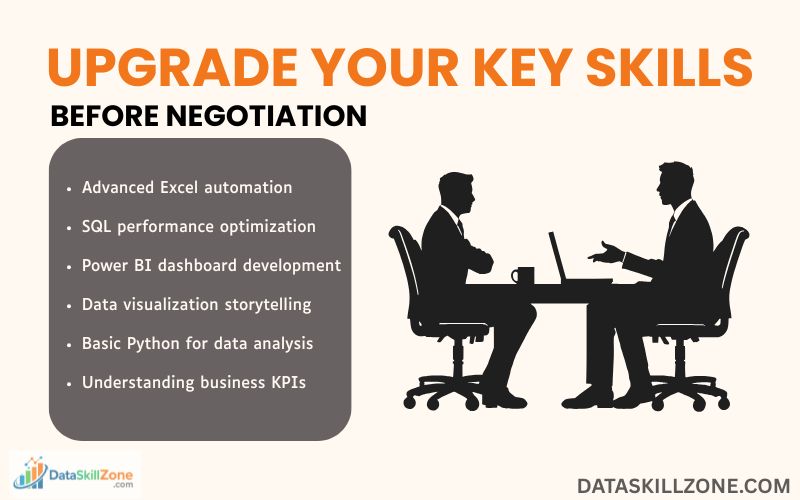
If you want to know how to get a salary raise without switching jobs, here’s a simple truth:
Skill growth increases negotiation power.
In a competitive data analytics career, the following skills significantly influence salary:
- Advanced Excel automation
- SQL performance optimization
- Power BI dashboard development
- Data visualization storytelling
- Basic Python for data analysis
- Understanding business KPIs
If your skills have grown significantly over the past 6–12 months, you hold a stronger position during a salary raise discussion.
If not, focus there first.
The best salary negotiation tips for working professionals always begin with improving value.
Salary follows capability.
Strengthening your technical foundation plays a big role in salary growth. Learning SQL for data analysis techniques can help you automate reporting, optimize queries, and deliver deeper insights to business teams.
Step 4: Choose the Right Timing

One of the most overlooked elements in how to ask for salary hike in data analytics is timing.
Best time to ask for salary raise in IT jobs:
- During annual appraisal cycle
- After successful project completion
- After receiving positive feedback
- When you’ve taken new responsibilities
- When business performance is stable
Worst timing:
- During layoffs
- After a major mistake
- During company losses
- In casual hallway discussions
Schedule a proper one-on-one meeting.
A formal meeting shows maturity and professionalism.
Step 5: Use a Structured Salary Negotiation Script
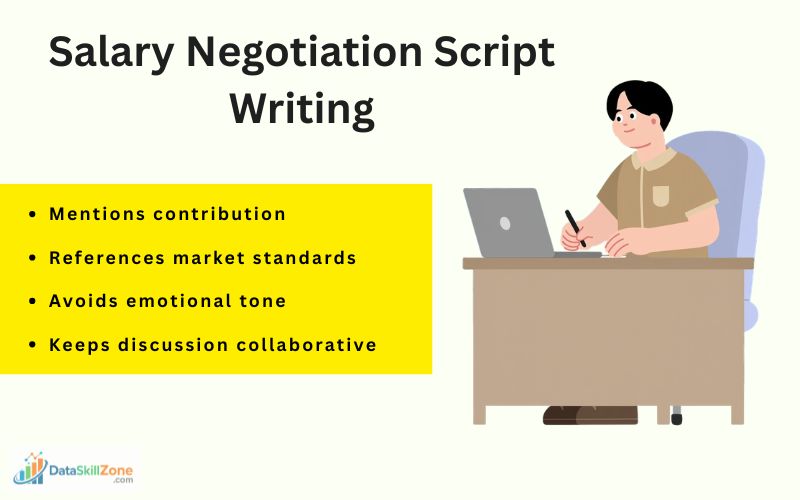
Most people struggle because they don’t know what to say.
Here is a practical example you can adapt:
“I’ve enjoyed contributing to our reporting and analytics initiatives this year. Over the past few months, I’ve automated key Excel reports, optimized SQL queries, and built dashboards that support decision-making. Based on my performance and current market standards for data analyst roles, I would like to discuss a possible salary adjustment. I’d appreciate your feedback on how we can move forward.”
This approach works because it:
- Mentions contribution
- References market standards
- Avoids emotional tone
- Keeps discussion collaborative
This is how to negotiate salary as a data analyst without sounding demanding.
Step 6: Prepare for Different Outcomes

Salary Negotiation Outcomes: What to Do Next
In most salary negotiation conversations, three outcomes are common:
- Immediate approval
- Delayed evaluation
- Conditional roadmap
If your manager says:
“Let’s review this in the next quarter.”
Respond with:
“What specific performance goals or skill improvements would position me for a salary increase?”
Now the conversation shifts toward a data analyst salary growth roadmap.
Instead of uncertainty, you get direction.
That clarity is powerful.
Should You Switch Jobs Instead?
Stay vs Switch: What to Consider
Sometimes internal growth is slow.
The data field is dynamic. Many professionals see significant increases in data analyst salary when they switch companies.
If:
- Your responsibilities have increased
- Your skills have improved
- Your salary remains stagnant
- Growth path seems unclear
Exploring external opportunities might make sense.
But even during job interviews, strong salary negotiation skills are essential.
Never accept the first offer blindly.
If you plan to explore better opportunities in the job market, make sure your resume clearly highlights your technical achievements and business impact. Preparing a strong data analyst resume that gets shortlisted can significantly improve your chances of receiving better job offers.
Common Mistakes During Salary Negotiation
Long-Term Salary Growth in Data Analytics
If you want consistent growth in your data analytics career, focus on three pillars:
1. Technical Depth
Master:
- SQL
- Advanced Excel
- Power BI
- Data modeling
- Automation mindset
These directly impact data analyst salary growth.
2. Business Understanding
Understand:
- Revenue drivers
- Cost structures
- Operational KPIs
- Industry metrics
Business awareness increases your influence.
3. Communication Skills
Learn to:
- Present dashboards clearly
- Explain insights simply
- Write structured summaries
Technical skills get you hired.
Business impact gets you promoted.
Communication increases your earning potential.
Career growth is not only about technical expertise. Developing workplace communication, leadership, and problem-solving abilities are also important. These skills that help professionals get promoted faster at work can significantly influence long-term salary growth.
How to Negotiate Salary After a Job Offer

Receiving a job offer is the best moment to start a salary discussion. At this stage, the company has already decided they want you on the team, which gives you more confidence to negotiate. Many professionals feel nervous during this stage, but understanding how to negotiate salary after receiving an offer can significantly improve your long-term earnings.
Before starting the conversation, take time to evaluate the offer carefully. Salary negotiation is not just about asking for more money; it is about presenting your value in a professional and respectful way. Employers usually expect candidates to ask questions about compensation, benefits, and career growth.
When preparing to negotiate your salary, keep the following points in mind:
- Research market salary data
Compare the offer with average salaries for similar data analyst roles in your city or industry. - Highlight your measurable impact
Mention skills such as SQL optimization, dashboard development, reporting automation, or data insights that improve business decisions. - Express enthusiasm for the role
Make it clear that you are excited about the opportunity while discussing compensation. - Provide a reasonable salary range
Instead of asking for a random number, suggest a range based on industry benchmarks. - Be open to discussing total compensation
If the company cannot adjust the base salary, you can explore bonuses, performance incentives, or additional benefits.
Learning how to negotiate salary professionally allows you to maintain a positive relationship with the employer while ensuring that your compensation reflects your skills and contributions. Over time, these conversations become easier and help build confidence in your career growth.
Salary Negotiation Tips Every Data Analyst Should Know

Understanding how to negotiate salary becomes much easier when you follow proven negotiation strategies used by experienced professionals. Many data analysts avoid discussing compensation because they fear rejection or uncomfortable conversations. However, salary discussions are a normal part of professional growth, especially in competitive fields like data analytics.
If you prepare well and approach the conversation confidently, salary negotiation can actually strengthen your professional image. Managers usually respect employees who clearly understand their value and communicate it in a structured way.
Here are some practical salary negotiation tips that can help data analysts achieve better compensation:
- Prepare evidence of your contributions
Before entering the discussion, list your achievements such as automated reports, SQL optimizations, improved dashboards, or time-saving processes you implemented. - Know the industry salary benchmarks
Research salary ranges for data analyst roles with similar experience levels. This helps you make a realistic and informed request. - Practice your negotiation conversation
Rehearse how you will explain your contributions and expectations. Practicing helps reduce nervousness during the discussion. - Stay professional and calm
Avoid emotional arguments or comparisons with colleagues. Focus on your performance, skills, and measurable results. - Be flexible and open to alternatives
If a salary increase is not immediately possible, discuss other benefits such as performance bonuses, training opportunities, or promotion pathways.
Learning these salary negotiation tips can help you approach compensation discussions with confidence and professionalism. Over time, these skills not only improve your earning potential but also demonstrate that you understand your value within the organization.
Key Takeaways
- Research salary benchmarks before negotiating
- Show measurable business impact
- Choose the right timing
- Stay professional and confident
- Keep upgrading Excel, SQL, and Power BI skills
Final Thoughts
Learning how to negotiate salary as a data analyst is part of professional maturity.
If you’ve improved your Excel skills, strengthened your SQL expertise, built impactful dashboards, and contributed measurable value -asking for a salary raise in data analyst jobs is not arrogance.
It’s responsibility.
The professionals who grow fastest in the data analytics career path are not just technically strong.
They are:
- Skill-focused
- Impact-aware
- Market-informed
- Confident communicators
Salary growth follows value creation.
If you consistently upgrade your skills and understand your market position, salary negotiation becomes less intimidating and more strategic.
Once you understand how to negotiate salary, compensation discussions become more strategic and less stressful.
And in the long run, that makes all the difference.
Your Value Deserves to Be Recognized
Keep improving your Excel, SQL, Power BI, and communication skills. The more value you create, the easier salary conversations, promotions, and better job offers become.
Frequently Asked Questions
Clear answers to the most common questions about salary negotiation for data analysts, job offers, raises, and career growth.
How do I negotiate salary politely?
Start with market research, highlight your measurable achievements, and explain your value professionally. Keep the conversation respectful and ask whether there is flexibility in the compensation package.
What if my manager says no to a salary raise?
If your manager says no, ask what specific goals, skills, or performance milestones would make you eligible for a raise in the future. This gives you a practical roadmap instead of uncertainty.
Should I switch jobs for a higher salary?
If your responsibilities and skills have grown but your pay has remained stagnant, switching jobs may help. Many data professionals increase their salary faster by moving to a new company.
How much raise should I ask for?
Many professionals ask for a 10–20% raise depending on their experience, market salary benchmarks, technical skills, and business impact. Use realistic salary data instead of choosing a random figure.
Can freshers negotiate salary too?
Yes, freshers can negotiate respectfully by highlighting certifications, internships, academic projects, technical skills, and current market salary trends. Even small improvements can make a difference early in your career.
What skills increase a data analyst salary fastest?
Advanced Excel, SQL, Power BI, dashboard storytelling, automation, business understanding, and communication are some of the most valuable skills that can improve salary growth in data analyst roles.

4 Comments