

 By
By Introduction
Let me tell you something honestly.
Most people don’t lose jobs because they are unskilled.
They lose jobs because of small resume mistakes they don’t even realize they’re making.
I’ve seen this again and again. A person has good Excel knowledge. Knows SQL. Even built dashboards. But their resume? Weak. Generic. Confusing.
And recruiters don’t have time to decode your potential.
They are not sitting there with coffee, carefully reading every sentence of your resume, trying to understand what you meant to say.
In reality, they are handling hundreds of applications for a single role. Their inbox is full. Their deadlines are tight. Hiring managers are asking for shortlists quickly.
So when they open your resume, they are not searching for hidden talent between the lines.
They are scanning.
They are looking for clarity.
They are looking for immediate signals that say:
“Yes, this person fits.”
If your resume makes them work too hard ; if your achievements are unclear, your skills are scattered, or your formatting is confusing — they won’t try to figure it out.
Not because you’re unqualified.
But because they simply don’t have the time to investigate.
What Recruiters Notice in the First 6 Seconds
- Job title relevance
- Important keywords
- Recent experience
- Clear achievements
- Readable formatting
- Professional structure
If these signals are missing, many resumes get skipped quickly.
If they don’t see those within seconds, they move to the next candidate.
It sounds harsh, but it’s practical.
Your resume is not a puzzle they want to solve.
It’s a document that should instantly communicate value.
And if it doesn’t do that quickly, your potential remains invisible – no matter how talented you are.
To avoid these mistakes completely, you can use tools from our guide on Top Free Resume Builder Tools in 2026.
The biggest resume mistakes in 2026 include using one resume for every job, missing ATS keywords, weak achievements, poor formatting, no projects, grammar errors, and unprofessional file names. Fixing these can improve interview chances fast.
1. Sending the Same Resume Everywhere (One of the Biggest Resume Mistakes)
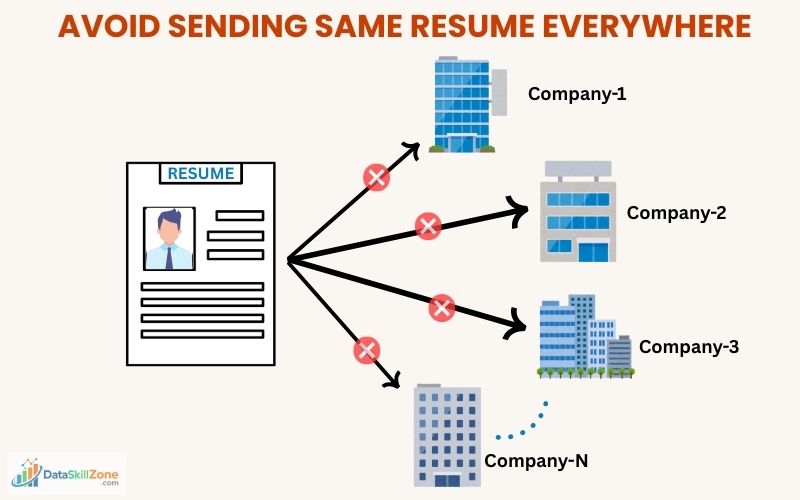
This is probably the most common resume mistake.
You create one resume.
Save it as “Final Resume Latest Updated New.pdf”.
And send it to 50 companies.
Feels efficient, right?
But here’s the problem.
Every job description is different. Different skills. Different priorities. Different keywords.
When your resume doesn’t match the job description, ATS systems may reject it before a human even sees it.
How to Fix This
Before applying:
- Read the job description properly.
- Highlight important keywords.
- Adjust your summary and skills section accordingly.
- Rearrange bullet points to match the role.
It takes 10 extra minutes.
But those 10 minutes can increase interview calls dramatically.
2. Writing a Boring Career Objective
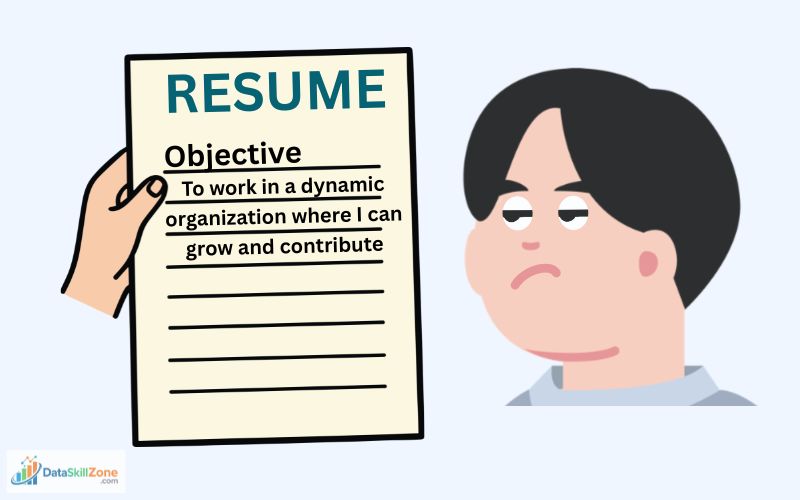
You’ve probably written something like:
“To work in a dynamic organization where I can grow and contribute.”
Be honest.
Does this tell anything specific about you?
No.
Recruiters read this line thousands of times.
It doesn’t hurt you directly.
But it doesn’t help you either.
And in a competitive job market, neutral means weak.
Fix It Like This
Instead of talking about what you want, talk about what you offer.
For example:
“Detail-oriented MIS Executive with 2+ years of experience in Excel automation and dashboard reporting. Helped reduce manual reporting time by 35%.”
Now that sounds real.
Now that sounds valuable.
3. Listing Responsibilities Instead of Results
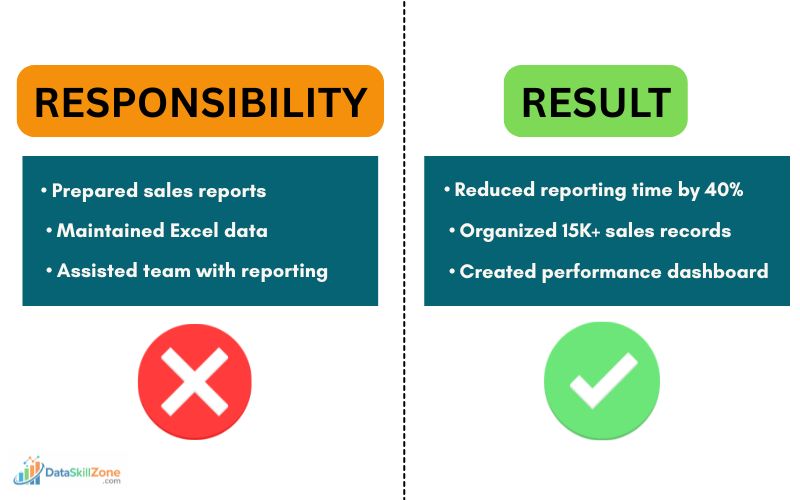
This is a silent killer among resume mistakes.
Many resumes say:
- Responsible for preparing reports
- Responsible for managing data
- Responsible for client communication
But think about it.
Being “responsible” doesn’t prove performance.
Anyone can be assigned responsibility.
Few can show impact.
How to Improve This
Add numbers.
Instead of:
“Prepared daily sales reports”.
Write:
“Designed automated sales dashboards that improved reporting speed by 40% and reduced manual errors”.
See the difference?
Numbers create trust.
When your resume clearly shows measurable achievements, it also becomes easier to justify your value during salary discussions.
Before vs After Resume Example
If you want to understand how to confidently discuss compensation with employers, you can read our detailed guide on how to ask for salary hike in data jobs.
4. Ignoring ATS Keywords
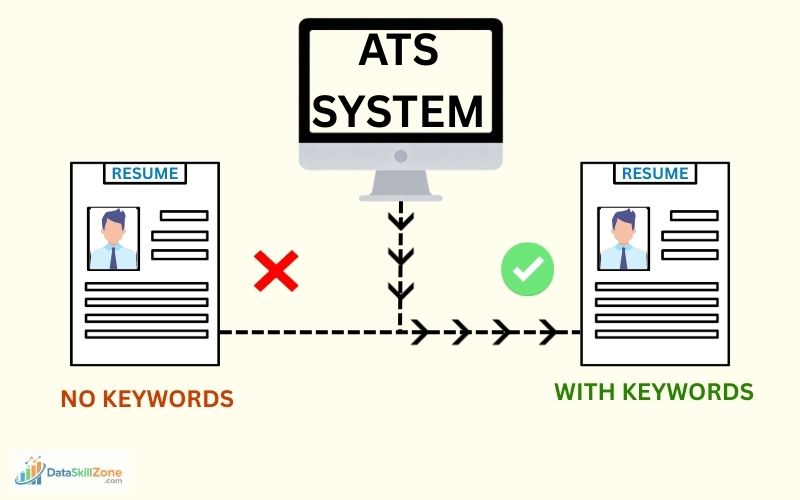
This is where many job seekers unknowingly lose opportunities.
Most companies now use Applicant Tracking Systems(ATS).
If your resume doesn’t contain relevant keywords, it might not even reach the recruiter.
For example, if a job description mentions:
- Advanced Excel
- Pivot tables
- SQL queries
- Data visualization
And your resume only says “Good in Excel” – you may get filtered out.
What You Should Do
Carefully read the job description.
Use exact skill phrases naturally in your resume.
Not by stuffing.
But by integrating them into achievements and skills.
This small change improves ATS compatibility significantly.
According to hiring insights shared by LinkedIn recruiters, most resumes are scanned in just a few seconds.
5. Overdesigning the Resume
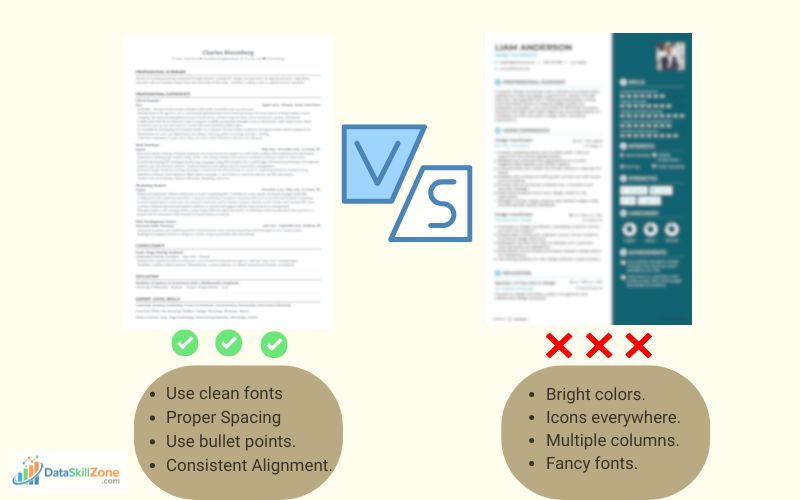
Some people treat resume like a graphic design project.
- Bright colors.
- Icons everywhere.
- Multiple columns.
- Fancy fonts.
Almost like they’re designing a social media poster instead of a professional document which might look very attractive, but is often unreadable by ATS.
And difficult for recruiters to scan quickly.
When a resume becomes too decorative, it often creates more confusion than impact.
Recruiters are not judging your artistic creativity (unless you’re applying for a designer role). They are looking for clarity, structure, and relevance.
Important details get buried under design elements.
- Text becomes harder to scan.
- Sections are not aligned properly.
- And sometimes, ATS systems can’t even read the content correctly because of complex formatting.
Remember, a resume is not meant to impress with colors.
It is meant to communicate value quickly.
Remember:
Recruiters spend around 6–8 seconds initially.
If your layout is confusing, they won’t struggle to understand it.
They will simply move to the next candidate.
Keep It Simple
- Use clean fonts (Calibri, Arial).
- Maintain proper spacing.
- Use bullet points.
- Keep alignment consistent.
Professional always beats flashy.
6. Making It Too Long
This is another common resume mistake.
Some people believe a longer resume = more impressive.
They think that the more pages they add, the more experienced and capable they will appear.
So they start including everything.
- Every internship.
- Every workshop was attended.
- Every small task handled.
- Even school-level achievements from 8–10 years ago.
Here’s the reality.
Recruiters are not measuring your worth by page count. They are measuring it by clarity and relevance.
A long resume doesn’t automatically signal experience. Sometimes, it signals lack of focus.
If you have 2–3 years of experience, your resume should ideally be 1–2 pages.
Anything beyond that usually contains unnecessary information.
Recruiters want clarity, not autobiography.
Cut:
- School-level achievements (if experienced)
- Irrelevant internships
- Outdated certifications
- Personal details like marital status
In fact, many hiring managers mentally appreciate candidates who can present their experience in a concise and structured way. It shows maturity. It shows communication skill. It shows that you understand what matters.
More content does not mean more value.
Better content means more value.
You don’t need to show everything you’ve ever done.
You only need to show what proves you’re right for this job.
And sometimes, removing unnecessary content makes your profile look stronger ; not weaker.
7. Not Adding Practical Projects
This is one of the most damaging resume mistakes — especially for freshers and career switchers.
Many candidates complete a course in Excel, SQL, Power BI, or digital marketing.
They learn concepts.
They watch tutorials.
They even practice small exercises.
But when it comes to the resume, they only write:
- Completed Excel course
- Basic knowledge of SQL
- Familiar with Power BI
And that’s it.
From a recruiter’s perspective, this doesn’t prove anything.
Because knowledge without application feels theoretical.
Companies don’t hire based on what you’ve studied.
They hire based on what you can do.
If your resume doesn’t show practical implementation, it looks incomplete.
But if you add:
Sales Performance Dashboard – Excel Project
- Cleaned and structured 15,000+ rows of raw sales data
- Used Pivot Tables and Advanced Formulas for analysis
- Designed dynamic dashboard to track regional performance
- Identified low-performing categories and suggested improvements
Now your profile looks skill-based. Companies hire ability, not just degrees.
The Simple Truth
- If you don’t show practical work, your resume looks theoretical.
- If you show real projects, your resume looks employable.
Especially in 2026’s competitive job market, skills alone are not enough.
Proof of skill is what gets interviews.
And projects are proof.
8. Spelling and Grammar Errors – One of the Most Common Resume Mistakes
This may sound like a small issue.
But in reality, spelling and grammar errors are one of the most damaging resume mistakes you can make.
Even a single typo can silently reduce your credibility.
Imagine applying for a job where attention to detail matters — like Data Analyst, MIS Executive, Accountant, HR, or even Marketing Executive.
And your resume says:
- “Excell” instead of Excel
- “Manger” instead of Manager
- “Responcible” instead of Responsible
It might seem minor to you.
But to a recruiter, it raises a question:
- “If this person can’t proofread their own resume, how careful will they be in real work?”
It signals carelessness.
Remember, your resume is not just a document.
It’s a reflection of your professionalism.
Always Do This
- Read your resume slowly.
- Check consistency of tense.
- Use grammar tools.
- Ask someone to review it.
Small effort. Big impact.
Your resume is the first impression you make.
If it contains errors, that first impression becomes weak – even if your skills are strong.
In a competitive job market, small mistakes create big consequences.
And this is one of the easiest resume mistakes to fix.
9. Random Skill Listing
This is one of those resume mistakes that looks harmless ; but quietly weakens your entire profile.
Many resumes have a skills section that looks like this:
- Excel, SQL, Leadership, Hardworking, Python, Honest, Communication, Teamwork, Power BI
At first glance, it seems fine.
You’ve listed your abilities.
But when a recruiter sees this, it feels unstructured and scattered.
- There’s no clarity.
- No categorization.
- No indication of strength level.
- No connection to your experience.
It almost feels like you wrote down every skill that came to mind.
They scan for patterns and structure.
If your skills section looks messy, it reduces professionalism.
How to Fix Random Skill Listing
Instead of writing everything in one line, organize your skills clearly.
For example:
Technical Skills
- Advanced Excel (Pivot Tables, VLOOKUP, XLOOKUP, Power Query)
- SQL (Joins, Subqueries, Data Filtering)
- Power BI (Dashboard Creation, DAX Basics)
- Data Cleaning & Data Analysis
Soft Skills
- Analytical Thinking
- Communication
- Problem-Solving
- Time Management
This structure immediately improves readability.
Now the recruiter can quickly identify your technical strengths.
It also improves ATS compatibility because job-specific keywords are clearly visible.
If you’re preparing for data roles, also read our guide on how to prepare a data analyst resume.
10. Unprofessional Email or File Name
You may laugh.
But resumes are still sent from emails like:
- coolboy123@gmail.com
Or file name like:
- FinalResumeLatestUpdated2.pdf
This creates a subtle negative impression.
Fix This Immediately
Use:
- firstname.lastname@gmail.com
And file name like:
- Abid_Ghori_Data_Analyst_Resume.pdf
Professionalism starts from small details.
Quick Comparison
Weak Resume vs Strong Resume
A recruiter usually decides within seconds whether your resume deserves more attention. The difference is not always your skill level. In many cases, it is how clearly and professionally your value is presented on the page.
Why These Resume Mistakes Are Dangerous in 2026
The Simple Reason Behind This
More candidates are applying for the same jobs, which makes strong resumes more important than ever.
Modern hiring systems scan resumes quickly and often remove weak matches before human review.
Recruiters often scan resumes in seconds, so clarity and structure matter immediately.
Companies now care more about proof of skill, projects, and measurable results.
A clean and relevant resume creates trust quickly and improves shortlisting chances.
A few years ago, small resume mistakes were sometimes ignored.
Recruiters had fewer applications.
Automation was limited.
Screening was more manual.
But 2026 is different.
The job market is more competitive than ever.
For one single job posting, companies now receive hundreds- sometimes thousands of applications within days.
And because of that, the screening process has become faster, stricter, and more automated.
That means small resume mistakes that were once overlooked are now becoming instant rejection triggers.
You might have the skills.
You might have the experience.
But if your resume contains avoidable resume mistakes, your profile never gets the opportunity to prove itself.
That’s why fixing these mistakes is not optional anymore.
It’s essential.
Because in a competitive job market, small improvements create big differences.
Final Resume Checklist Before You Apply✅
Final Check
Before clicking the apply button, take one last look at your resume. A few careful checks can prevent small mistakes from quietly reducing your interview chances.
My Final Short Suggestion:
Improving your skills is important.
But presenting those skills properly is equally important.
Many talented candidates remain unnoticed simply because of avoidable resume mistakes.
Don’t let that be your story.
Fix these today.
Your next interview call might just depend on it.
Your Resume Can Open Doors
Small resume fixes can create big career results. Improve clarity, show achievements, and present your value confidently.
Frequently Asked Questions
Clear answers to the most common questions about resume mistakes, ATS issues, and improving interview chances in 2026.
What are the biggest resume mistakes in 2026?
The biggest resume mistakes in 2026 include sending the same resume to every job, ignoring ATS keywords, listing duties instead of achievements, overdesigning the layout, and skipping practical projects.
Do ATS systems reject resumes automatically?
Yes, ATS systems can filter out resumes automatically if they do not match important keywords, job titles, or required skills mentioned in the job description.
How long should a resume be in 2026?
For most job seekers, a resume should be one to two pages long. The goal is to keep it concise, relevant, and easy for recruiters to scan quickly.
Should I add projects on my resume?
Yes, especially if you are a fresher or career switcher. Practical projects show that you can apply your skills to real tasks, which makes your profile stronger and more credible.
What file name should I use for my resume?
Use a clean and professional file name such as YourName_Resume.pdf or Abid_Ghori_Data_Analyst_Resume.pdf. Avoid random names like FinalResumeLatestUpdated2.pdf.
Can resume mistakes really reduce interview calls?
Yes. Even small resume mistakes can reduce interview chances because recruiters spend only a few seconds scanning resumes before deciding whether to shortlist a candidate.

4 Comments