

 By
By Introduction – I Didn’t Choose MIS. MIS Slowly Chose Me.
The MIS executive career path is often the starting point for many professionals who want to build a career in the data field.
I began my journey working with Excel reports and business data, and over time I learned how data analysis and reporting can influence business decisions.
Let Me tell you one thing, When I started my professional career, I did not dream about building a career in MIS and data analytics. Like many freshers entering corporate jobs, my primary goal was stability, a fixed salary, job security, and some growth.
Data reporting, analytics tools, corporate performance management, and business intelligence all seemed aloof and technical at the time.
I joined as an MIS Executive without fully understanding the long-term scope of the data analytics career path in India. For me, it was just about preparing Excel sheets, maintaining reports, and sending updates.
But slowly, I realized something powerful.
Data is not just numbers.
Data drives decisions.
Data controls strategy.
Data influences revenue.
And the person handling data holds silent power inside the organization.
That realization changed everything.
If you’re curious about the real responsibilities involved in this role, you can explore my daily workflow as an MIS executive to understand how reporting and data management tasks are handled in practical business environments.
The MIS executive career path can lead to data analytics roles by building strong skills in Excel, reporting, business understanding, communication, SQL, dashboards, and continuous learning.
Understanding the MIS Executive Career Path
The MIS executive career path usually begins with handling reports, organizing business data, and supporting management with accurate information. Over time, professionals in this role gain valuable analytical and reporting skills that can lead to higher positions in the data and analytics field.
Here are the key stages and responsibilities typically involved in the MIS executive career path:
Key responsibilities in the early stage
Data Collection and Organization
MIS executives gather data from multiple sources such as sales reports, CRM systems, and spreadsheets. This data is then cleaned and structured for reporting purposes.
Preparing Daily and Weekly Reports
One of the main responsibilities is creating reports that help managers track performance, sales trends, and operational activities.
Using Excel for Data Management
Most MIS professionals rely heavily on Microsoft Excel to manage large datasets, perform calculations, and generate summaries using functions, Pivot Tables, and formulas.
Maintaining Data Accuracy
Ensuring that reports are accurate and updated regularly is an essential part of the role. Even small errors in data can impact business decisions.
Excel reporting played a major role in my growth. You can read more about how I improved my Excel skills while working with large datasets and business reports.
If you want to grow faster in reporting roles, explore our complete guide on Excel Skills for Data Analysis to learn formulas, Pivot Tables, dashboards, and practical reporting techniques.
Phase 1 – When I Believed Hard Work Alone Guarantees Promotion

In my early corporate life, I believed something very simple:
If I work harder than everyone else, I will grow faster.
So I:
- Reached office early
- Stayed late without complaint
- Replied to emails instantly
- Completed tasks before deadlines
- Avoided mistakes carefully
I thought this dedication would automatically result in career growth, salary increment, and job promotion.
But after a year, reality hit me.
Some employees who worked fewer hours were getting:
- Better projects
- Higher visibility
- Strategic roles
- Better appraisal ratings
That confused me deeply.
I started searching online about how to get promoted faster in a corporate job, and one thing became clear, companies reward value, not just effort.
There is a huge difference between:
Being busy
and
Being impactful
This was my first big lesson in professional development and career advancement strategy.
Phase 2 – Upgrading My Excel and Data Reporting Skills

Professionals working in reporting roles often rely on functions, pivot tables, and formulas explained in the official Microsoft Excel documentation.
When I honestly evaluated myself, I realized my technical skills were average. I knew basic formulas, but I was not confident in advanced reporting.
In today’s competitive market, especially in high-paying data jobs and MIS executive roles, basic Excel is not enough.
So I decided to improve.
I focused on:
- Advanced Excel formulas (INDEX-MATCH, nested IF, logical functions)
- Pivot Tables for data analysis
- Dynamic dashboards
- Data cleaning techniques
- Error-proof reporting systems
- Basic automation for productivity
At first, it was difficult. After office hours, learning Excel felt exhausting. But I reminded myself, this is an investment in my long-term data analytics career growth.
Within months, something changed.
- My reports became visually professional
- Managers asked fewer corrections
- My analysis started influencing decisions
- Senior management trusted my numbers
In the corporate world, advanced Excel skills for data analysis are a high-CPC skill set because they directly impact revenue and operational efficiency.
That was the moment I understood:
Technical skills increase your professional market value.
As professionals gain experience, the MIS executive career path can expand into roles such as data analyst, reporting specialist, or business intelligence professional.
Phase 3 – Understanding Business, Not Just Data

Initially, I was only preparing numbers.
Later, I started interpreting numbers.
There is a big difference.
Instead of sending raw sales data, I began analyzing:
- Why did revenue decline this week?
- Which region is underperforming?
- Which product has high growth potential?
- What trend is visible in monthly reporting?
When you start thinking like this, you move from “reporting executive” to “business contributor.”
In the world of business intelligence, financial reporting, and corporate data management, companies value employees who can connect data with decision-making.
This shift improved my credibility significantly.
Now I wasn’t just sending Excel sheets.
I was contributing insights.
And insights are powerful in the data-driven corporate environment.
Many beginners also explore online data analytics learning resources to improve their practical skills and understand real datasets.
Phase 4 – Communication: The Skill That Changed My Visibility
Let me admit something openly.
Communication was my weakest skill.
I had knowledge, but I lacked confidence in meetings. Especially when speaking English in front of seniors.
I often searched topics like:
- how to improve workplace communication skills
- how to speak confidently in office meetings
- corporate communication tips for professionals
One sentence from my senior changed my mindset:
“Your work is good, but you need to explain it better.”
That sentence hit me hard.
From that day, I started:
- Speaking in small internal meetings
- Explaining my reports clearly
- Improving business vocabulary
- Practicing English daily
- Watching professional presentation videos
Initially, I felt nervous. But gradually, I improved.
Now:
- I present dashboards confidently
- I explain data trends clearly
- I participate in discussions
In high-growth careers like data analytics, business intelligence, and corporate reporting, communication skill is directly linked with leadership opportunities.
You may have technical expertise, but without communication, your growth becomes slow.
That was one of my biggest breakthroughs.
Phase 5 – Discipline and Time Management Reduced My Stress
Earlier, my work routine was chaotic.
I worked hard but without structure. That created unnecessary stress during month-end reporting and performance review cycles.
Then I made small but powerful changes:
- Daily task prioritization
- Time blocking method
- Reducing mobile distractions
- Reviewing reports before submission
- Planning weekly deliverables
These habits improved my productivity dramatically.
Stress reduced, errors became fewer, and my confidence improved noticeably.
In high-performance environments like corporate finance, MIS reporting, and data management roles, time management is not optional — it is essential.
Discipline gave me mental clarity.
Phase 6 – Continuous Learning Became My Career Insurance
One truth about the data field:
If you stop learning, you start declining.
Technology evolves. Tools upgrade. Business expectations change.
So I began exploring:
- SQL for beginners
- Basic data analytics concepts
- Dashboard tools
- Business intelligence fundamentals
- Automation tools for MIS professionals
I didn’t learn aggressively.
Just consistently.
Even 20–30 minutes daily over one year creates massive transformation in data analytics career opportunities.
Continuous learning improved:
- My confidence
- My professional profile
- My long-term earning potential
In high-CPC domains like data science, analytics, and business intelligence careers, skill upgrade directly impacts salary growth.
As I continued upgrading my skills, learning databases became important. You can read our practical guide on SQL for Data Analysis to understand how SQL helps in reporting and analytics careers.
Common Mistakes That Slow MIS Career Growth
Many MIS professionals work sincerely and still feel stuck in the same position for years. In most cases, the issue is not lack of effort. The problem is that some habits look normal on the surface but quietly slow down long-term growth.
Doing Reports Without Understanding the Business Meaning
Many MIS professionals prepare reports exactly as asked, send them on time, and move to the next task. This creates a routine work pattern, but not always a growth pattern. Career growth becomes stronger when you stop seeing reports as only numbers and start asking better questions. Why did sales fall? Which region is underperforming? Which product trend matters most? Once you begin connecting reports with business decisions, your role becomes more valuable.
Staying at Basic Excel Level for Too Long
Basic Excel can help you survive in an MIS role, but advanced Excel usually helps you grow. When professionals stay comfortable with only simple formulas and manual reports, their value often stays limited. Strong growth usually comes when you improve Pivot Tables, lookup formulas, dashboards, data cleaning, and structured reporting skills. The difference becomes visible in the quality of your work, your speed, and the trust people place in your reports.
Ignoring Communication Skills
Some people do excellent work but struggle when they have to explain it. This becomes a silent career barrier. If you cannot present a report clearly, explain a trend confidently, or speak well in front of seniors, your effort may remain less visible than it deserves. Communication does not mean speaking fancy English. It means explaining your work simply, clearly, and with confidence. In reporting and analytics roles, this skill often increases visibility faster than people expect.
Working Hard Without a Learning Plan
Many MIS professionals stay busy all day and assume that experience alone will automatically lead to growth. But without a learning plan, growth often becomes slow. Office work teaches responsibility, but skill-building creates career mobility. Even a simple weekly plan for improving Excel, learning SQL basics, understanding dashboards, or reducing manual work can create a huge difference over time. Consistency matters more than intensity here.
Waiting for Opportunity Instead of Building Readiness
Some professionals wait for the perfect project, the perfect manager, or the perfect promotion cycle before they start improving themselves. But in real careers, opportunity usually comes after preparation. The people who grow faster are often the ones who keep building skills even when no one is asking them to. They improve before the opportunity arrives, not after it appears.
Simple truth: Most MIS professionals do not stay stuck because they lack talent. They stay stuck because they remain busy, but not intentionally growth-focused.
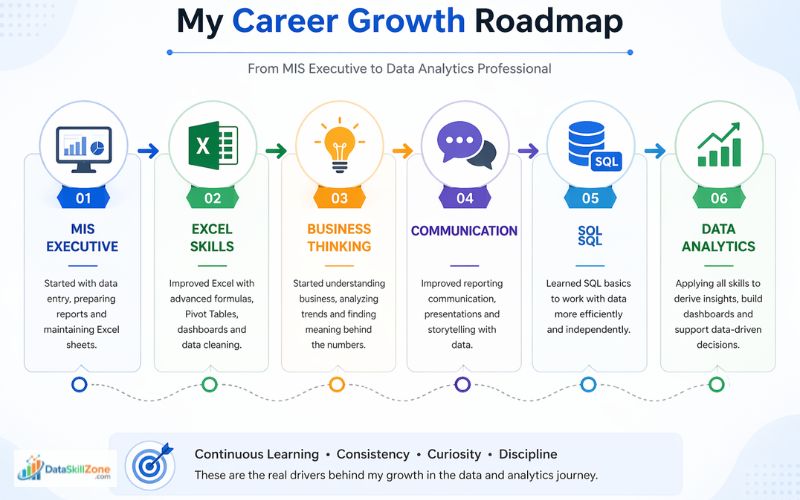
My Career Growth Timeline
Before vs After My Career Growth
This transformation did not happen through luck.
It happened through:
- Consistency
- Skill building
- Professional discipline
- Continuous improvement
Key Growth Opportunities in the MIS Executive Career Path
With the right skills and experience, MIS professionals can move into higher-value roles across analytics, reporting, business intelligence, and leadership.
📊 Data Analyst
Move into analysis roles using SQL, Power BI, Excel, and business insights.
📈 BI Specialist
Build dashboards, visual reports, and strategic decision systems.
⚙️ Reporting & Automation
Create faster workflows, automated reports, and efficient processes.
💼 Business Analyst
Use data insights to solve business problems and improve strategy.
🗂️ Data Operations
Manage data quality, datasets, and operational planning systems.
🚀 Team Leadership
Lead reporting teams, projects, and junior analysts with experience.
If dashboard creation and data visualization interest you, I have also covered a complete guide on How to Become a Power BI Developer for professionals who want to move into BI roles.
What Truly Helped Me Build My Career in MIS and Data Field
If I summarize everything in simple words:
- Strong technical skills
- Clear business understanding
- Effective communication
- Time management discipline
- Continuous learning mindset
- Positive professional attitude
No shortcut.
No favoritism.
Only preparation.
Once you start moving toward analytics roles, it’s also important to prepare a data analyst resume that highlights reporting, analytical, and technical skills.
Skills That Changed My Career Growth
90-Day Growth Plan for MIS Professionals
- Month 1: Improve Excel formulas and reporting speed
- Month 2: Learn SQL basics and dashboard concepts
- Month 3: Build projects, improve communication, update resume
5 Signs You’re Ready to Move from MIS to Data Analytics
If you already work with reports and business data, you may be closer to analytics than you think. These signs usually show that you are ready for the next step.
- You enjoy analyzing trends instead of only preparing reports.
- You ask business questions when numbers change.
- You want to build dashboards instead of static sheets.
- You are curious about SQL, Power BI, or automation tools.
- You want your work to influence decisions, not just support reporting.
What I Wish I Knew Earlier
I used to think career growth depends only on luck, company politics, or waiting for the right opportunity. Later I learned that growth usually starts when you improve your skills, your mindset, and the way you create value every day.
Final Words – If You Feel Stuck in Your MIS Job
If you are currently working as an MIS Executive or planning a career in data analytics, and you feel stuck.. I understand that feeling.
But remember:
You are not stuck.
You are underprepared.
Start improving one skill at a time.
Learn advanced Excel.
Understand business reports.
Improve communication.
Build analytical thinking.
In the long run, the data field offers high-paying career opportunities, professional stability, and strong growth potential ; but only for those who invest in themselves.
I am still learning.
Still growing.
And that is the real career journey.
If you are starting your MIS executive career path, focus on building strong technical and analytical skills.
Your Current Role Can Be Your Launchpad
Even if you start with reporting work today, the right skills can open bigger analytics opportunities tomorrow.
Frequently Asked Questions
Clear answers to the most common questions about the MIS executive career path and growth into data analytics roles.
Is the MIS executive career path a good career option in India?
Yes, the MIS executive career path is a strong starting point for professionals interested in reporting, business data, and analytics. It can lead to long-term growth in data analyst, business intelligence, and reporting roles.
What skills are important for success in the MIS executive career path?
Important skills include advanced Excel, reporting automation, data analysis, SQL basics, dashboards, business understanding, communication, and time management.
Can the MIS executive career path lead to data analytics roles?
Yes. Many professionals move from MIS roles into data analyst, business analyst, reporting analyst, or BI roles after upgrading their technical and analytical skills.
How long does it take to grow in the MIS executive career path?
Growth depends on learning speed, company opportunities, and consistency. Many professionals see strong progress within two to five years with continuous improvement.
What are the common responsibilities of an MIS Executive?
Common responsibilities include collecting data, preparing reports, maintaining dashboards, ensuring data accuracy, analyzing trends, and supporting management decisions.
Is Excel enough to grow in an MIS career?
Excel is an essential foundation, but long-term growth becomes stronger when combined with SQL, Power BI, automation tools, communication skills, and business understanding.

5 Comments