

 By
By Introduction: How I Really Started My MIS Journey
When I first started working as an MIS Executive in an office environment, I never imagined how important this role was in a company.
Like many beginners in India, I used to think MIS job was only about Excel sheets and sending daily reports.
But after working for almost five years in sales reporting and data management, I got to know that MIS executive daily workflow involves much more than just formulas.
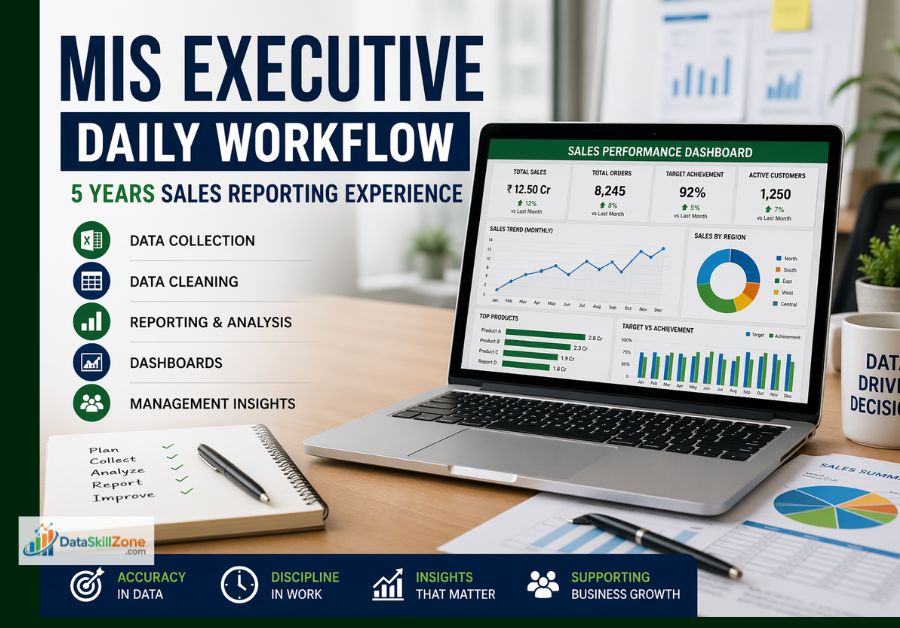
The daily workflow of an MIS executive mainly revolves around collecting data, cleaning spreadsheets, preparing reports, and creating dashboards that help management make data-driven decisions.
It includes handling pressure, managing deadlines, coordinating with sales teams, maintaining data accuracy, and supporting management decisions.
In this blog, I am sharing my real MIS executive sales reporting experience, so that beginners and working professionals can understand how MIS work happens in reality.
When I joined my first office job as an MIS Executive, I still remember that day clearly.
New desk.
New computer.
New colleagues.
New pressure.
Inside my mind, I was thinking:
“Bas Excel aata hai, kaam ho jayega.” (ie..I thought knowing Excel was enough.)
But within just one month, I understood one thing very clearly.
MIS job is not only about Excel.
It is about responsibility.
It is about accuracy.
It is about staying calm when everyone else is in panic mode.
After working for almost 5 years in a corporate environment, especially handling sales reports, I decided to write this blog.
Not to show off.
But to help those freshers and beginners who are confused, scared, and nervous, just like I was in my early days.
This is my real story.
No theory.
No fake motivation.
Only real office life.
The MIS executive daily workflow includes collecting sales data, cleaning Excel files, preparing reports, building dashboards, checking accuracy, managing deadlines, and supporting management decisions with reliable business data.
Who Should Read This Article?
- Freshers who want to understand real MIS office work
- Professionals preparing for MIS Executive interviews
- Employees working in reporting or Excel-based roles
- Anyone planning to move from MIS to Data Analyst roles
- Students exploring career options in data and reporting
What Does an MIS Executive Do Every Day?
- Collect sales or operational data from different departments
- Clean and validate Excel datasets
- Prepare daily MIS reports
- Create dashboards and performance trackers
- Identify trends and performance gaps
- Share reports with management teams
Designing a clear and structured report is an important part of the MIS reporting process. If you want to understand this process in detail, you can also learn the step-by-step method to design MIS reports for sales, HR, and finance teams in Excel.
A Typical MIS Workday at a Glance
How My Office Day Actually Begins
Morning Routine: Emails, Calls, and Pressure

My day starts the moment I open my system.
The Best funny part was, before even opening Excel, I open:
- Outlook
- WhatsApp
- Company software
And within minutes, messages start coming.
“Kindly Update on yesterday’s Report.”
“Today’s target update?”
“Need Distributor data at the earliest”
Sometimes, I haven’t even taken my first sip of tea.
Earlier, this used to stress me.
Now, I follow one simple rule.
I make a small to-do list.
On paper or in Excel.
- Daily sales report
- Pending files
- Corrections
- Follow-ups
This small habit saves my entire day.
Collecting Sales Data: The Most Tiring Part
Collecting sales data is one of the most important responsibilities in MIS executive job.
In most of the corporate companies, sales data does not come from one single system. It comes from sales executives, supervisors, distributors, billing departments, and sometimes even manual records.
Many times, data is incomplete, delayed, or wrongly formatted. As an MIS executive in sales department, my daily work includes calling team members, sending reminders, and verifying files to ensure accuracy.
This coordination is necessary to maintain a proper MIS reporting system in the company and to prepare reliable sales reports for management.
Reality of Data Collection
Many people think MIS people just sit and get data.
No.
We have to chase data.
Sales data comes from:
- Sales executives
- Supervisors
- Distributors
- Billing department
- ERP system
Some send on time.
Some forget.
Some send wrong file.
Some send photo of paper.
So I have to:
Call them.
Message them.
Remind them.
Sometimes I feel like a call center agent 😄
But this coordination is part of the job.
Cleaning Data: Where Real MIS Work Happens

My Biggest Learning from Mistakes
In my first year, I trusted raw data.
Big mistake.
One day, I sent report without checking properly.
Later, manager called me and said:
“Data is Inaccurate or not completed.”
That moment was embarrassing.
After that day, I became very careful.
Now, before sending any report, I check:
- Duplicate entries
- Missing sales
- Wrong dates
- Wrong amounts
- Extra spaces
I use:
- Filters
- Remove duplicates
- Conditional formatting
- Basic formulas
Cleaning data is boring.
But it protects your respect.
Working with Excel Every Single Day
As We all Know Excel is the main working tool for every MIS executive.
In my daily work, I use Microsoft Excel for preparing sales reports, analyzing performance, and managing databases. Functions like XLOOKUP, VLOOKUP, Pivot Tables, IF formulas, SUMIFS, and Power Query help me save time and reduce manual work.
Over the years, I learned that strong Excel skills are essential for anyone who wants to grow in MIS reporting or data analyst career. Without Excel knowledge, it becomes very difficult to handle large sales data and meet office deadlines.
In many cases, raw business data needs to be cleaned and structured before it becomes a professional report. I have also explained my complete process of converting raw data into professional MIS reports with practical examples.
Real Tools I Use in My MIS Daily Workflow
Over the years, these tools helped me work faster, reduce mistakes, and manage reporting pressure more effectively.
Excel Is My Best Friend Now
In the beginning, Excel scared me.
Too many formulas.
Too many options.
Now, it is my daily tool.
I regularly use:
- XLOOKUP / VLOOKUP
- Pivot Tables
- IF / IFS
- SUMIFS
- COUNTIFS
- Power Query
Microsoft Excel is one of the most important tools used by MIS professionals for data analysis, reporting, and dashboard creation. You can explore more about Excel features in the official Microsoft Excel documentation.
One funny thing:
Most files are named:
final.xlsx
final2.xlsx
final_latest.xlsx
final_last.xlsx 😄
Only MIS people understand this pain.
One useful Excel feature that helps in MIS reporting is drop-down lists, which allow users to standardize data entry. You can learn how to create a drop-down list in Excel step-by-step in this guide.
Preparing Daily Sales Reports Under Pressure
Preparing daily sales reports is one of the most critical tasks in MIS executive workflow.
These reports show total sales, product-wise performance, area-wise growth, and target achievement. Management uses these reports to take business decisions. That is why accuracy and timely submission are very important.
In my starting days, I used to take more than one hour to prepare daily reports. But after gaining experience and creating templates, I can now prepare Excel sales reports within minutes. This improvement helped me handle work pressure and build trust with seniors.
Daily Reports: No Delay Allowed
Daily reports are urgent.
They include:
- Total sales
- Area-wise sales
- Product performance
- Target vs achievement
Manager usually wants it fast.
So I prepared templates.
Now I just paste data and refresh.
Earlier, it took 1 hour.
Now, 15 minutes.
Experience matters.
Weekly and Monthly Reports: More Responsibility
Weekly Analysis
Weekly reports show trends.
Which area is improving?
Which is falling?
Here, thinking is more important than speed.
Monthly Reports
Monthly reports are serious.
Management plans based on this.
So I double-check everything.
One zero extra or missing can create big confusion.
Making Dashboards for Managers

Making Data Look Simple
Managers don’t like long tables.
They want charts.
So I prepare dashboards.
Using:
- Excel charts
- Pivot charts
- Sometimes Power BI
Good dashboard = less explanation.
Handling Deadlines and Office Pressure
Working as an MIS executive in sales reporting department means working under constant pressure.
Many times, data comes late, systems become slow, and managers demand reports urgently. There were days when I had only ten minutes to prepare important reports.
In such situations, only experience, preparation, and system management help.
Through these challenges, I learned how to manage stress and maintain quality work. This practical exposure helped me grow professionally and prepared me for higher roles in data reporting and analytics.
A Day When Everything Went Wrong
There was a day when data came late, the system was slow, files had errors, and management needed the report urgently. I felt pressure immediately. But because I had templates, backup files, and a calm mindset, I handled the situation. That day taught me that preparation matters most when things go wrong.
Real Situation from My Experience
One day:
Sales data came at 5:20 PM.
Manager wanted report at 5:30 PM.
Only 10 minutes.
My system was slow.
My heart was fast.
But because I had templates, I managed.
That day taught me:
Preparation saves career.
File Management and Backup System
Why I Became Disciplined
Earlier, I saved files anywhere.
One day, important file got deleted.
I panicked.
After that, I changed.
Now I follow:
- Proper folders
- Date-wise naming
- Cloud backup
- Pen drive backup
Small habit. Big impact. Better safety.
Communication with Sales Team and Managers
Soft Skill Matters More Than You Think
MIS is not a silent job.
You talk daily with people.
Some are friendly.
Some are rude.
Some blame you.
You must stay calm.
Professional behavior builds long-term respect.
Mistakes I Made in My Early Career
Learning the Hard Way
I made many mistakes:
- Wrong formulas
- Late reports
- Formatting issues
- Confusion
But I didn’t quit.
I learned.
Today, those mistakes made me strong.
Skills That Helped Me Grow in MIS
How MIS Job Built My Career Foundation
Many people think that MIS executive job has limited growth, but this is not true.
With proper skills and learning mindset, MIS professionals can move into data analyst, business analyst, reporting manager, and operations analyst roles.
My MIS executive experience helped me understand business data, reporting systems, and management requirements.
This knowledge created a strong foundation for my long-term career in data and analytics field. For anyone who wants to build a stable career in India, MIS reporting is a good starting point.
Many MIS professionals also transition into analytics roles. Here is a guide on how to move from MIS to data analyst.
MIS Is Not Small Job
Many people think MIS is a small role.
No.
It teaches business deeply.
From MIS, you can become:
- Data Analyst
- Reporting Manager
- Business Analyst
It is strong foundation.
Honest Advice for Freshers
From My Heart
If you are starting:
Don’t run behind salary.
Run behind skills.
Learn Excel.
Observe seniors.
Ask doubts.
Practice daily.
Success will come.
Challenges of MIS Sales Reporting Job
Reality Check
This job has:
- Pressure
- Long hours
- Repetition
- Less appreciation
But if you stay consistent, growth comes.
My Learning Habit After 5 Years
Why I Still Study
Even now, I learn.
New formulas.
New automation.
New dashboards.
Learning keeps you valuable.
Final Thoughts: My MIS Journey
When I look back, I feel proud.
From nervous beginner to confident professional.
MIS taught me:
Discipline.
Confidence.
Responsibility.
It changed me.
MIS Executive Career Growth Snapshot
| Stage | Typical Focus |
|---|---|
| Beginner | Excel reports, data cleaning |
| Mid-Level | Dashboards, automation, ownership |
| Growth Path | Data Analyst / BI / Reporting Lead |
What MIS Really Taught Me
MIS did not only teach me reporting. It taught me discipline, pressure handling, responsibility, business thinking, and the value of accurate work.
Conclusion: Should You Choose MIS Career?
Yes — if you are ready to work hard.
Yes — if you love data.
Yes — if you are patient.
MIS is not easy.
But it is rewarding.
My five-year journey as an MIS executive taught me that this role is not just about preparing reports. It is about supporting business growth through accurate data, disciplined working style, and continuous learning.
According to career experts, MIS executives are responsible for collecting business data, preparing reports, and supporting decision-making with accurate information. You can read more about the role and responsibilities of an MIS executive.
From handling daily sales reports to building dashboards and managing databases, every task helped me improve professionally. If you are planning to start your career as MIS executive or want to move into data analyst field, focus on developing Excel skills, understanding reporting systems, and gaining practical office experience.
With patience and dedication, MIS career can give you long-term success.
Keep learning, stay disciplined, and use every report as practice for future growth.
Frequently Asked Questions
Clear answers to the most common questions about the MIS executive daily workflow, sales reporting tasks, and real office responsibilities.
What is the daily workflow of an MIS executive?
The MIS executive daily workflow usually includes collecting data from different departments, cleaning Excel files, validating records, preparing reports, updating dashboards, and sharing business insights with management.
What skills are required for the MIS executive daily workflow?
Important skills include advanced Excel, attention to detail, reporting accuracy, time management, communication, analytical thinking, and the ability to work under deadlines.
How do MIS executives convert raw data into reports?
MIS executives collect raw data, clean errors, organize records into structured tables, and then create summary reports using formulas, Pivot Tables, dashboards, or reporting templates.
What reports are commonly prepared by MIS executives?
Common reports include daily sales reports, monthly summaries, target vs achievement reports, area-wise performance reports, dashboards, and business review reports.
Can MIS executives move into data analyst roles?
Yes. Many MIS professionals transition into data analyst, business analyst, or BI roles after improving SQL, Power BI, dashboarding, and analytical skills.
Is MIS executive a good career for freshers in India?
Yes. MIS is a strong starting role for freshers because it builds real office experience, reporting discipline, Excel skills, business understanding, and a foundation for future analytics careers.

6 Comments